

Updated July 2026.
Qi2 25W changes the product conversation in a useful way. The headline is higher charging power, but a successful charger still depends on the whole system: the phone, power adapter, cable, transmitter, magnetic geometry, firmware and thermal path. If one part is underspecified, the user will not see the performance promised on the box.
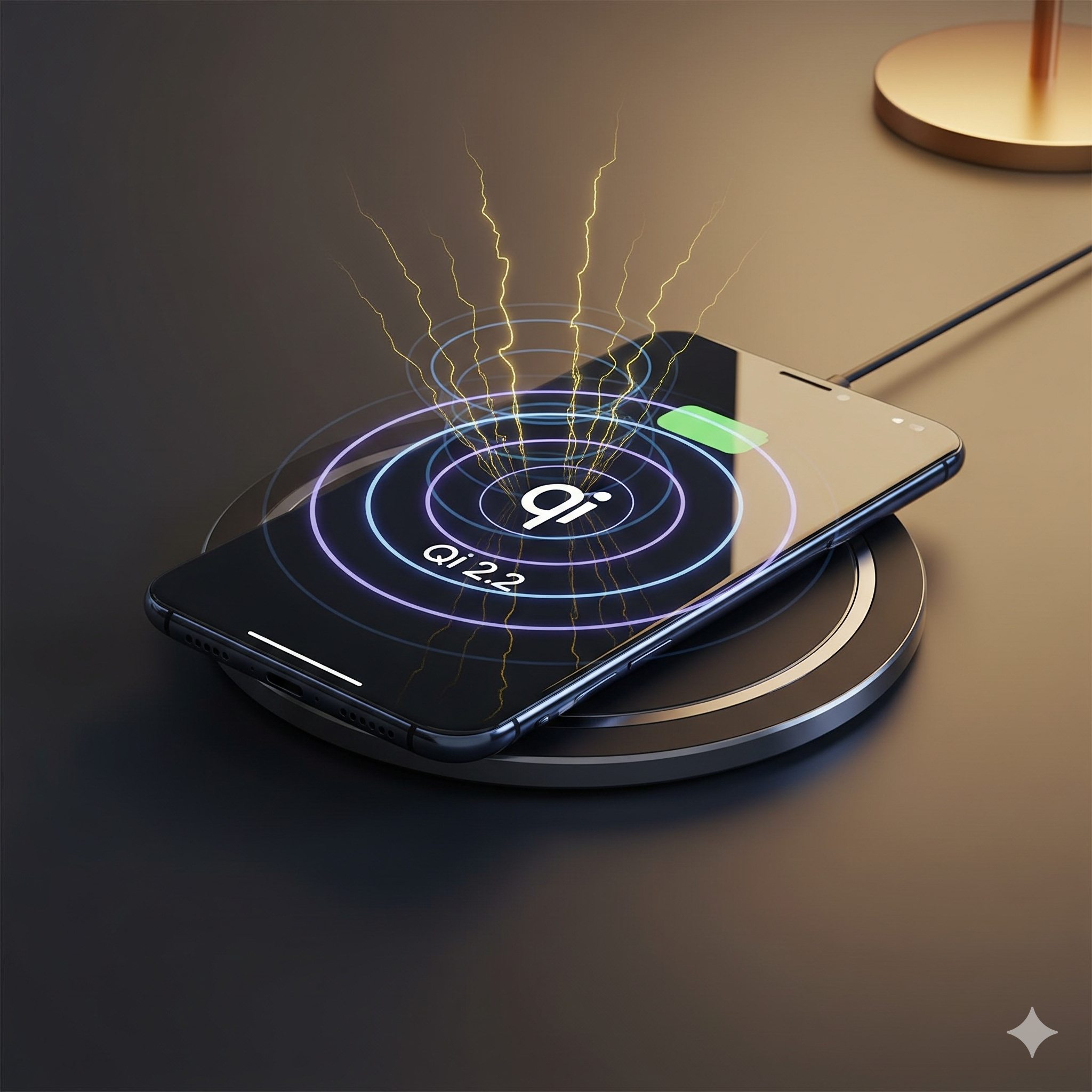
The Wireless Power Consortium (WPC) identifies Qi v2.2.1 as Qi2 25W and says it launched in July 2025. That wording matters. “Qi2.2,” “25W magnetic charging” and “Qi2 25W certified” are not interchangeable marketing phrases. A finished product should only be described as Qi Certified when its exact model appears in the WPC certified product database.
What product teams gain from Qi2 25W
The obvious benefit is shorter charging time for compatible devices. WPC describes the move from 15W Qi2 to 25W as nearly 70% more charging power. For buyers, however, the more durable benefit is a defined magnetic and communication framework that brings the phone and transmitter into repeatable alignment.
Repeatability is important in real products. A charger that works only when the phone is positioned with care may pass a desk test but fail in a car, hotel room or bedside product. Magnetic alignment reduces placement variation, but it also creates mechanical questions: magnet grade, ring position, attraction force, case compatibility, camera-clearance and the way the assembly is retained inside the enclosure.
Higher power makes thermal design more visible
A 25W design cannot be evaluated by the controller IC alone. Coil resistance, ferrite selection, switching losses, enclosure material, internal air volume and ambient temperature all affect sustained power. A prototype may briefly report a high input value and then reduce output as temperature rises. That is why a useful validation plan records power and temperature over time, rather than relying on a single meter reading.
For an OEM project, ask for a thermal test in the intended enclosure and at the intended ambient temperature. A thin plastic stand, a leather-wrapped desktop charger and a closed vehicle console do not dissipate heat in the same way. The coil-to-surface distance and any decorative layers must also be included in the test stack.
The adapter and cable are part of the product
Wireless performance begins on the wired side. The required USB-C PD profile, cable current rating and connector temperature should be defined before packaging is approved. If a charger is sold without an adapter, the manual and product page need a clear input recommendation. Otherwise, support teams will receive “slow charging” complaints caused by an incompatible power source.
Certification is a model-specific claim
There are three states that buyers should keep separate:
- Designed to a Qi2 requirement: an engineering intention, not a certification result.
- Certification in progress or pending: testing may be planned or underway, but the product is not yet certified.
- Qi Certified: the exact product has a public Qi ID and database record.
A certified subsystem can reduce development uncertainty, but it does not automatically make every finished product built around it certified. Enclosure, coil, firmware, power path and other implementation details still need to match the approved configuration. Market-specific safety, EMC, radio or environmental obligations are also separate from WPC certification.
Questions to settle before requesting a quotation
- Which phones and cases must be supported, and at what sustained power?
- Is the product a finished charger, a TX module, or a complete TX/RX system?
- What enclosure material and coil-to-device distance are expected?
- What input source and USB-C PD profiles are available?
- What ambient temperature, surface-temperature limit and duty cycle apply?
- Does the exact model need WPC certification, and who owns the certification work?
- Which destination markets and compliance reports are required?
Where CowinLink fits
CowinLink works on finished wireless chargers and embedded transmitter and receiver solutions. For a Qi2 25W project, our first step is an engineering review of the target device, mechanical stack, power input, thermal limits and certification plan. That review is more useful than choosing a module from a headline specification alone.
If you are planning a new product, send the device list, enclosure drawing, available space, input power and target market through our project inquiry form. We can then identify the questions that should be resolved before tooling or certification begins.
Primary reference: Wireless Power Consortium—Qi wireless charging.